RPGs Never Change - Reading RuneQuest 2e
I picked-up a copy of RuneQuest, 2nd Edition, on a lark a few weeks back after Twinkee in the Table Shapers Discord server shared a link to some tabletop eBay finds. While I doubt I'll ever run a game using it, it's been a fruitful read. Released in 1980, only six years after Dungeons and Dragons is published, it is a snapshot of where RPG design was in the U.S. and that design and the writing have me thinking about how the hobby has and has not changed in 46 years and how I feel about this.
Designed by Steve Perrin and Ray Turney, RuneQuest situates the player's character in Greg Stafford's Glorantha, a world of bronze-age pulp fantasy. It explicitly sets itself apart from other fantasy role-playing games (FRPs) by attaching itself to Glorantha and making an explicit effort toward to be realistic. It goes about this by stepping away from the class-based design of D&D and focusing on training one's skills and spells as the means of advancing, all with the explicit goal of accruing enough renown and wealth for a character join a Rune cult and acquire a magical Rune.
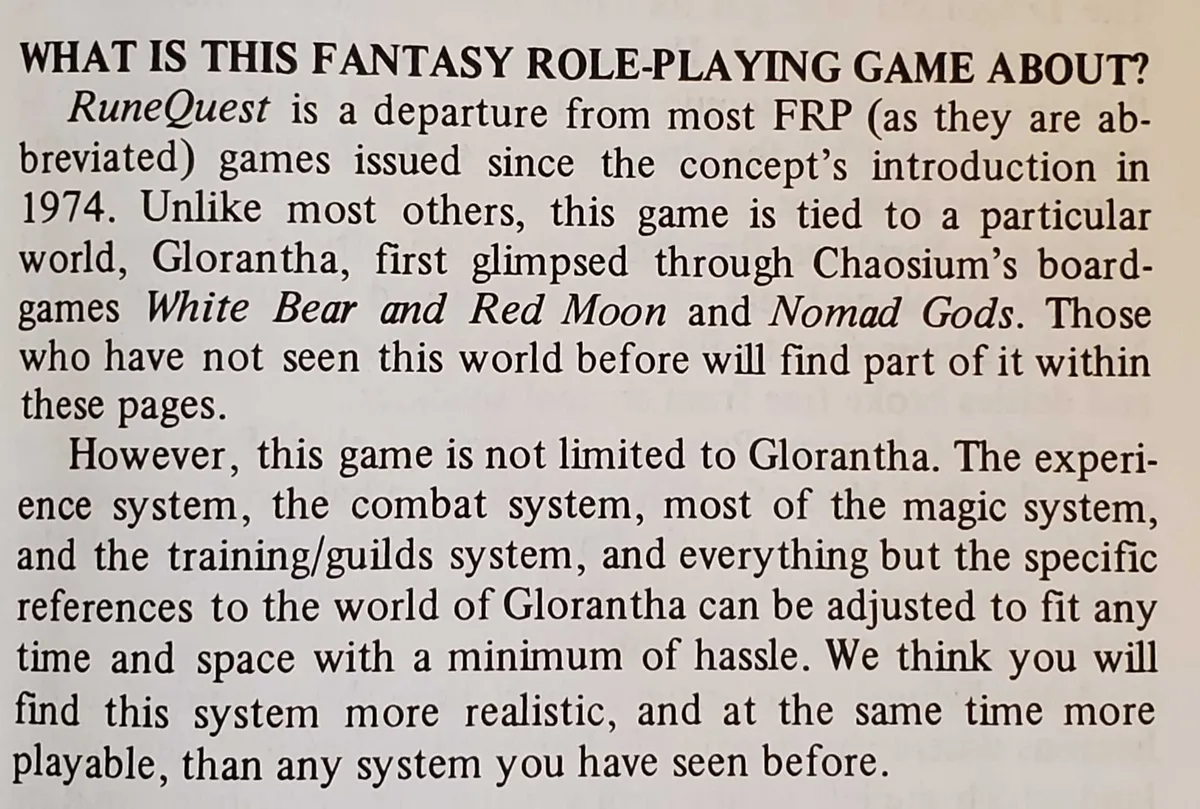
All of this is on page one. And that first page and the preceding acknowledgments were striking to me. Here is a game reacting to D&D and making very deliberate design and writing choices that feel unexpectedly timeless. This is a book whose opening paragraph describes role-playing by analogizing it to "improvisational radio theatre." You know - an actual play podcast.
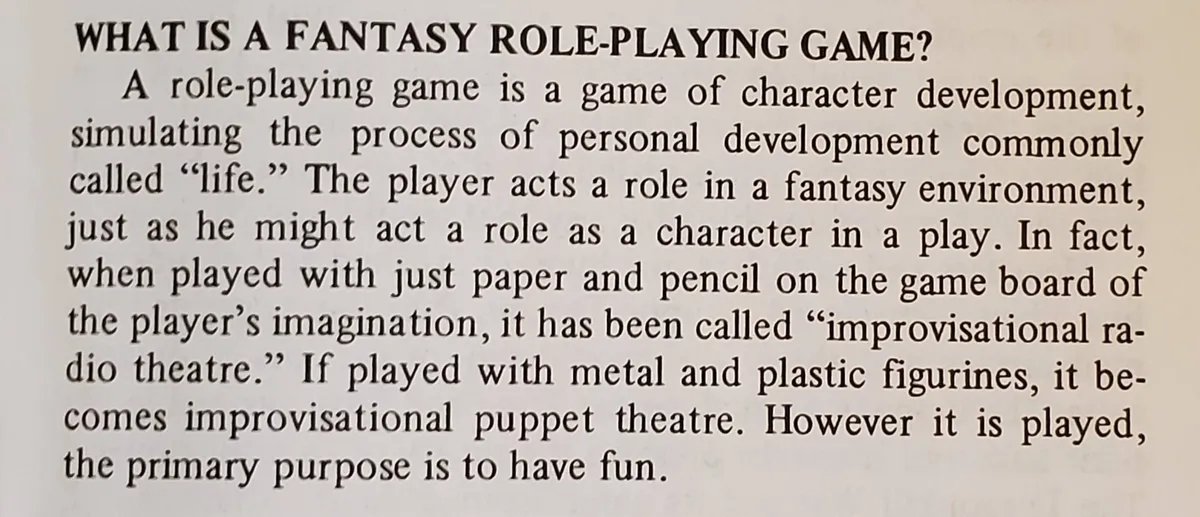 "[I]mprovisational puppet theatre" is probably the wildest way I've seen tabletop RPGs described, but it ain't wrong!
The acknowledgements are a half-page long and stand out. First because it includes direct thank you to Dave Arneson and Gary Gygax for creating the hobby. But also, because it thanks Ken St. Andre, creator of Tunnels and Trolls, for effectively ensuring the hobby (or business) didn't remain soley D&D. It then goes onto thank a few dozen playtesters and the 'zines Alarums and Excursions, The Wild Hunt, and The Lords of Chaos.
Sly nod to St. Andre aside, I've seen this several times before. The gratitude to Arneson and Gygax is so rote in a particular kind of RPG that it is more remarkable when it is absent. But the thanks given to the 'zines speaks to me. It's the same thing you see when a dungeon game acknowledges the blogs they read or cites the rules they took from another, similarly small game. The sense that this game came out of a broader community, and is beholden to that community.
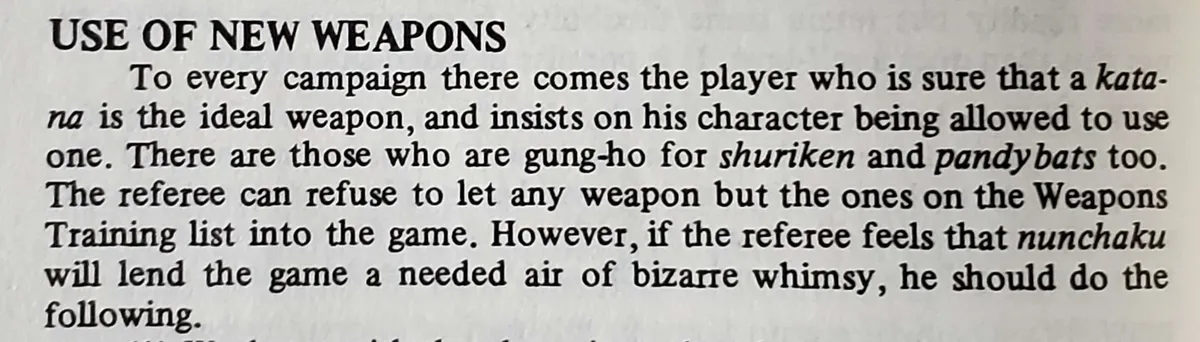
The rest of the book is the rules of play and a primer on Glorantha as a setting. While none of it affected me as much as the acknowledgment and introduction, bits and pieces jumped out. Some were exasperating, like the short bit near the end providing advice on how to handle the player who shows-up and wants to wield a katana or nunchucks. I have been on both sides of that conversation! Some drove-home how much of RuneQuest is D&D at its roots - this is a game with pumpkin-headed bugbears, paralyzing ghouls, and thoughts on how intelligent different thinking people can be.
Others felt unique to its time. This is a game where you can fight a duck-man, or if you work it out, play one - nothing says 1980 more than letting you play Howard, Scrooge, or Donald. But it's also a game designed for lonely play. So much of the rules are about planning how to spend your character's treasure on training, with elaborate math formulas to determine how many days and how much coin it takes to improve one's ability to parry, make antidotes, or cast a spell. This in-fiction training time is so long that the writers advise the game master allow for one day of real world time to equate to one week of in-game time. This kind of "lonely play," the game you can play when you are waiting for your next session, is rarer now.
Some bits are both a moment-in-RPG-time as well a reoccurring and timeless. To determine your initial skills your character takes out a loan from guilds to buy training from them. This becomes the cornerstone of The Elder Scrolls, with the early parts of those games inevitably directing you to the fighter, thief, and mage guilds.1 A whole branch of design that by-and-large dies out in tabletop games, but is preserved in video games.
All of this left me feeling unmoored in time as I read RuneQuest. I get this way whenever I read about the early days of roleplaying games. I have to confront the ways that games I play today constantly reinvent or explicitly pull from older games. It creates a sense of connection with folks I've never met. It positions me as belonging in a community I cannot directly know. It exhausts me with the ways nothing changes. And it comforts me to see folks make the same choices I make.
None of this is unique to RPGs. I suspect everyone wrestles with their place in time. Everyone has nostalgia for things they never experienced. But RuneQuest 2e pulled that out of me. A game that I will never run. A game I will probably never play! But I appreciate that it gave me a chance to wrestle with the passing of time.
Probably not a surprise. Ken Rolston worked on both RuneQuest and The Elder Scrolls in lead positions.↩